What are organizations doing about it? (Or not doing?)
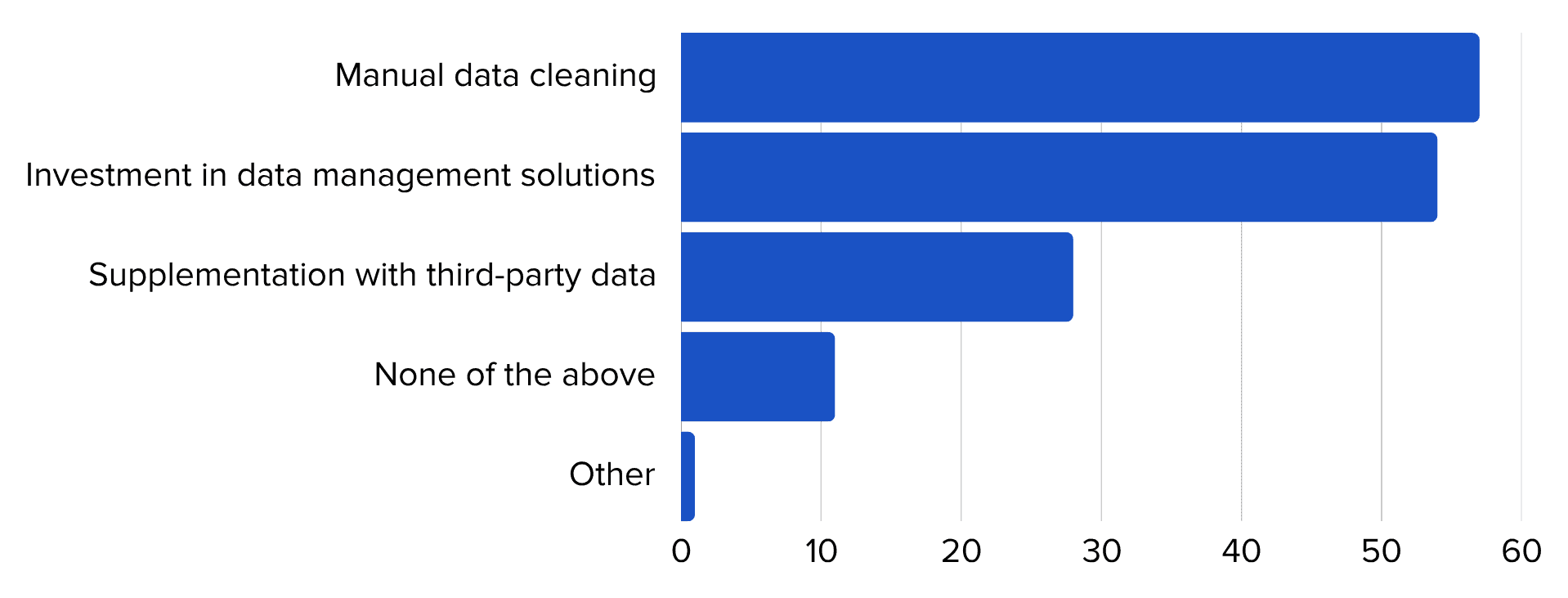
Faced with growing data quality concerns, organizations are trying a variety of tactics to clean their CRMs—but many still rely on short-term fixes instead of long-term solutions.
Here are a few themes we uncovered.
Of the organizations who said they didn't have an employee responsible for CRM data quality, only 18 percent plan to hire one in the next year. That marks a 56 percent decrease from our 2024 findings—suggesting a growing reluctance to invest in talent to solve data problems.
Over half of respondents said their organization relies on manual data cleaning efforts to improve CRM quality—an eight percent increase from last year. While this hands-on approach can yield quick wins, it’s time-consuming, error-prone, and difficult to scale across large, complex data environments.
Just 28 percent of organizations said they’re enriching CRM data with third-party sources—a 20 percent decrease from 2024's report. This method, while helpful for filling in missing information or validating records, has risks. Third-party data can introduce new inaccuracies, erode stakeholder trust,
and create compliance risks (especially in regions with established data privacy laws like GDPR). Without proper governance, validation, and transparency, data supplementation can end up compounding the very problems it’s meant to solve.
So, while most organizations are doing something, few are tackling CRM data quality in a truly strategic way.